Wednesday, April 6, 2011

Greek Hospitality

I tend to have a recklessly casual travel style when it comes to recreational travel (e.g. going to Mt Olympus when it’s closed because I won't be back for a few years). While this often tends to get me lost, I'd be lying if I didn't also admit that this has led to some of my best experiences while travelling.

Having said that, it can also lead to me being at the mercy of the locals. While I'd like to think I have the street smarts to get by, I also have to admit that the kindness inherent in the Greek culture makes it particularly easy.

Maybe it’s because they have had a seafaring culture for centuries / millennia and are accustomed to disoriented visitors arriving from around the world, but I have always had a deep respect for Greek hospitality, an important theme in the Odyssey by Homer, one of my favourite books. This also reminds me of one of my favourite scenes: Book VIII – The Games, when Ulysses meets Euryalus.

Context: Ulysses is lost. It's the whole premise of the book. And throughout, he experiences either kindness or evil from different characters. In this book, he arrives on the shore of the House of Alcinous. During the feast, the blind poet, Demodocus, sings songs of Ulysses' exploits, ironically, not knowing he is in the room. Ulysses' weeping is noticed only by Alcinous, who proceeds to distract his guest by suggesting they compete in athletic competitions instead.

During the competition, Alcinous's son, Laodamas, the best boxer, thinks to invite Ulysses to participate and Euryalus foolishly insults him when Ulysses politely declines due to the ravages of “infinite trouble” he’s experienced making his heart heavy for home. Ulysses proceeds to throw the heaviest disc the furthest distance (without even taking off his jacket) and proceeds to challenge anyone and everyone to any contest of their choosing (except for running due to his old age, and except for Laodamas, Alcinous' son, of course, respecting the role of the host's family). Alcinous politely calls Euryalus an idiot and calls for more festivities, hoping to prove to Ulysses that while the Phaeacians were not known for their athletic prowess, he was hoping to prove that they are exceptionally hospitable: “extremely fond of good dinners, music, and dancing”.

After acknowledging the spectacle of dancing, Ulysses compliments Alcinous, to which Alcinous responds by asking the twelve chief men (thirteen with himself) to give him “a clean cloak, a shirt, and a talent of fine gold”. Having disrespected Ulysses by supposing him to be unathletic and breaking the Greek code of hospitality to foreigners, Euryalus apologizes by giving him a gift: a beautiful bronze sword. Ulysses, making peace with his new friend, accepts the gift graciously, remarking that he hopes Euryalus will never have need of it.

(Read the original as this paraphrasing doesn’t do justice to the original poetry. Plus, there is a hilarious adulterer's story of warning told by Demodocus of Hephaistos, Venus and Aries)

As my highschool english teacher once explained, the concept of gift giving was important in Greek culture in that it emphasized the role of both gift giver and acceptee. It symbolized the greatness of the giver to be able to offer a gift as well as the importance of the recipient by being shown respect through the offer of a gift.

Tuesday, April 5, 2011

Climbing Mount Olympus


This is an instruction guide for anyone who might be interested in visiting Mount Olympus on a student budget. I thought I should write this down as I had unusual difficulty getting details and will probably be back here again sometime. After arriving in Thessaloniki, I got instructions, searched the internet and otherwise asked around for how to climb Mount Olympus:

Getting to Litohoro from Thessaloniki
  1. From Thessaloniki airport, take the 78 bus into the city (it goes along Tsimiski street), buy the two ride ticket which costs 1 euro (allows two trips within 90 minutes if I read the instructions correctly)
  2. From Thessaloniki, take the 31 bus from Egnatias street (one major street north of Tsimiski)
  3. Take the 31 bus to the end of the line to Makedonia bus station
  4. Go to the booth for KTEL (Greece public transit, similar to Greyhound) Platform 4 – Litohoro (or Litochoro, multiple spellings)
  5. Buy a ticket (student fair is for Greek students only), one way was 8 euro, return was 14
  6. Go to Platform 4 and take the bus (it is quite frequent, between one or two hours per bus)
  7. The bus stops at Katerini (Don’t get off)
  8. The ride to Litohoro is about an hour and drops you off in the city center
Note: There is a KTEL bus from Athens to Litohoro too. I don’t know where it leaves from, but I’ll find out tomorrow when I go to Athens from Litohoro.


Litohoro

The entire climb is along the E4 International Walking trail. Here you have two choices:

Choice 1: Scenic climb From Litohoro to Prionia

From the city center (the water fountain where the KTEL bus drops you off), walk straight past the Hotel Aphrodite and go right, past the residential housing, school and cemetery and past the power / utility plant (There are some dual language signs pointing the way to Olympus National Park).

You will reach the first gate which has signs saying “Olympus National Park”. The climb from Litohoro to Prionia is through the gorge of Olympus, and takes between 4.5 to 5 hours (or more if you take your time, relax and take photos) to go up. There are beautiful cliff faces and crystal clear waterfalls.


Choice 2: Skip with Taxi to Prionia (cost 25 to 30 euro one way, 20 minute drive)

If you come to Litohoro in the off season (season this year starts May 13th), then the refuges will be closed and your best bet is to climb the gorge. It is absolutely beautiful and mildly challenging. I promise you will enjoy it's undulating terrain. However, many people "cheat", take a taxi to the top and climb down or climb up and hitchhike down. It is a 5 hour hike one way afterall.

Above: Like Mount Kinabalu in Kota Kinabalu, Sabah, Malaysia (which I plan on doing again with a friend of mine this summer), you can expect to see a lot of this on your way up.

If you come to Litohoro when the refuges are open, then take the taxi to Prionia as it will be taxing enough just to make it to the refuge which is the midpoint from Prionia to the peaks of Mt. Olympus.

People often give advice to “book in advance”, but I was unable to find any good websites or information on ANYTHING, transport to Litohoro from Thessaloniki, accommodation etc.

I’m currently staying in the Hotel Mirtos in Litohoro which is charging me 30 euro a night (keep in mind this is the off season, I think I’m the only guest and they are currently under construction so I have no idea how much it costs when the tourists come in the on season). Tel 23520 81398.

Apparently, Refuge A (which from what I gather is the best one to be in) can be reached at 23520 81800. They spoke English when I called.

Good luck!

Saturday, April 2, 2011

Cheerio!

Later tonight (or, more accurately, early tomorrow morning) I will be flying out of London for Thessaloniki, Greece for my last course: Service Management Field trip, a consulting based project where we work with local companies. While the class doesn’t start until the third week of April, I’ll be in Greece and surrounding countries travelling.

So I apologize in advance if there are few posts between now and then. But who knows? In the country that spawned famous philosophers and mathematicians, maybe there will be some inspiration. Plus, I still have a few small assignments to complete for MCT.

Being Made Whole in Bankruptcy

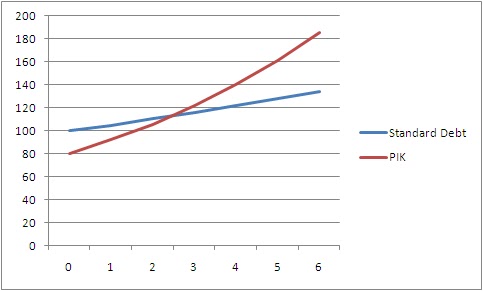
In our discussions in our Managing Corporate Turnarounds class during our financial restructuring session, I got to thinking about what it would take to be made whole in a bankruptcy scenario. While the hard math will tell you that it is impossible in the short term (EV = 80, Net Debt = 100), I began to think back to the PIK and using a high yield to restore value in the future. So my question became this: If I hold the debt of an insolvent company, what can I negotiate to help me restore value? The most obvious solution is to renegotiate the terms of my debt which will probably result in me taking a haircut (discount) on the principal or face value of my debt. However, we’ve acknowledged that in scenarios where people become riskier, obviously the company’s related securities should bear a higher return. So my question then evolved to: If I have to take a discount of X percent, what additional spread Y would I have to earn in order to be made whole in N years. It turns out:

FV x (1 + kd) ^ N = FV x (1 – X) x (1 + kd + Y) ^ N


However, this assumes that you can break even with (or more accurately, catch up to) where your security would have been if the company had not defaulted to begin with. After playing with these numbers, however, it was quite clear that even with a small discount (say 20% discount), the spread Y had to be astronomically (unreasonably) higher in order to have any chance of being made whole relative to the standard debt, so I thought it would be unrealistic not to include a factor which accounts for the value lost:

FV x (1 + kd) ^ N = FV x (1 – X) x (1 + kd + Y) ^ N + Value Lost


In trying to understand what these numbers mean, I looked at Value Lost / FV as a proxy for the default rate of this type of security in distress which is obviously closely tied to the actual economic circumstances of the company. In the graph, it is reflected by the distance between the Standard Debt curve and the PIK (Realistic) curve.

Also, Y can probably be determined by looking at the spread between similar bonds with different credit ratings (dropping from BBB to C for instance).

X is reflective of the economic scenario (so if EV was 80 and Net Debt was 100, X would be 20%). It is also reflective of the negotiations, as well as considering a discount in order to liquidate the current assets of the company.

Another problem is also that once a company switches from PIK to cash sweep, its risk profile drops and it stops earning high yields, dropping the return on capital and therefore making it impossible to “catch up”. Also, a bank which was happy to finance your debt will not be interested in converting neither into a mezzanine structure better suited for hedge funds nor into equity.

This model is similar to the VC model of predicting the failure rate using the discount rate except in reverse. It is also similar to the interest rate parity (IRP) model and boot strapping by using compounding to determine where you would have / should have been otherwise as a benchmark for where you are going.

I guess the real lesson is that bankruptcy is really expensive and that being made whole in this scenario is difficult, regardless of the financial engineering and patience, although these two factors can be used to ease the pain.

Thursday, March 31, 2011

Managing Corporate Turnarounds - Part II

Wednesday

Often when things go wrong, people are inclined to fire the management. However, in the real world, things are hardly ever that simple. Firing management, like anything in turnarounds, is decided on whether or not this action will speed up or slow down the turnaround. Besides packages given to executives on exit, there is also a great deal of institutional knowledge that they take with them. There is a counter balance to understanding the value they bring through their experience versus the inertia they create against the changes required. This is particularly true in SMEs as well as family owned enterprises where the institutional knowledge is often not formalized (pricing mechanics, customer relationships etc.)

Also, with the separation of the chairman and CEO roles, it is possible that a power divide coupled with an inappropriate strategy may have smart people being told to chase bad strategies. One remedy which is often used is an immunity period: the idea that employees in a turnaround situation have a window of opportunity to identify any potential problems. This allows an honest analysis of problems without reprimand and realigns expectations (Are we going to make the numbers? Are our margins as good as we expect? Are we doing things right? Are we doing the right things?) Because a new team is put into place to fix previously created problems, it is not appropriate to assign current problems to new management. However, eventually, whether or not these issues were created by you initially you will inevitably begin to wear them if you don’t fix them soon enough or don’t manage expectations of the company and all stakeholders.

Thursday

Like in any business strategy, there are two major things to keep in mind in a restructuring: operations and financing. For operations, it is necessary to check if the overall business strategy works (are people buying your product and do you have a viable business) and if you are able to profitably deliver (are our margins good or are we chasing low quality customers). Also from a financing perspective, it is important to understand the liquidity constraints of the enterprise. For example, what is an appropriate financing structure to keep the company alive while providing adequate and appropriate protection and returns to current and new capital providers?

One such useful tool is the paid-in-kind (PIK) security. It is a type of mezzanine high yield debt that doesn’t pay a coupon. Typically, these types of securities return 14 to 17%. They return higher than senior debt because they are subordinated but they don’t require cash payments which allow the company to maintain its liquidity for short period of time when it’s heavily cash strapped. However, what usually happens is this is coupled with a cash sweep. To use a structure like this in this circumstance is tantamount to saying: “We understand you are strapped for cash now, so you don’t have to pay us immediately, but we want an appropriate return for taking this risk that’s more similar to equity if things recover. However, we still want to be paid sooner rather than later and when you have any excess cash, you will give us everything you have and we’ll consider you less risky and ratchet down your interest rate to reflect the change in risk.”

Tuesday, March 29, 2011

Artistry with Dr. Hilary Austen

Tonight, there was a Rotman panel discussion hosted at the Savoy Hotel in London by our dean, Roger Martin, on “Artistry Unleashed: Pursuing Great Performance in Work and Life” written by Dr. Hilary Austen. They had a great discussion on how our current educational system seems to focus heavily on quantitative knowledge potentially at the expense of qualitative knowledge which, although by definition difficult to measure, plays an important role not just in decision making, but our ability to perform well in different environments.

Vetran integrative thinkers can probably also recognize the concept of model tension between these two ideas and can appreciate that the conversation between the panelists with Roger facilitating lead to interesting perspectives and topics being raised (eg. the role of analytical versus intuitive recognition for diagnosis performed by doctors).

Afterwards, there was a cocktail reception with the opportunity to speak with people connected to the Rotman community in London through a variety of different channels: students like myself, alumni, business partners, patrons of business publications etc.

Managing Corporate Turnarounds

This week, I’m taking a block week course (one week intensive following the 10 week standard course period) at LBS: Managing Corporate Turnarounds. So far this course has actually been really interesting, with us looking at business cases for salvaging distressed companies and learning about the mechanics and considerations of struggling businesses.

Unlike my undergraduate strategy course, which I nicknamed “doom and gloom” because the distressed companies in our cases never seemed to recover, this course talks about different cases that were successfully turned around using a variety of different techniques to improve operational efficiencies and use financial tools like LBOs to capture the upside.

We’ve also had great guest speakers come talk about their specific experiences and their perspective on different aspects of turning companies around (shedding assets for cash, improving operations, recovering debt, how to identify target companies etc.) One of our requirements in class is to summarize some key learnings from the class, and in a similar fashion to the Latin America study tour which had a similar component, I plan on using this blog to jot a few notes for me to recall later as I compile my thoughts:

Monday

In turning a company around, it is important to understand where control lies. Since equity is flirting with bankruptcy, it may lose control to the debt holders. Some debt investors may be holding “grenades”, the intent to liquidate their holdings ASAP when a trigger event happens (broken covenants, default etc), and may not be interested in salvaging the company, even if there is potential to recover equity value because they just want to unwind their positions.

Companies need to have good strategies when it comes to M&A, otherwise they can fall victim of a vicious cycle: accretive acquisitions increase EPS (albeit in an inorganic manner) and can give false impressions of growth, which could potentially boost the P/E multiple. A higher P/E multiple gives the company expensive equity which it can use as a better transaction currency for buying other companies (low P/E) and still be accretive. This is a vicious cycle if the M&A is not well integrated with substantial delivery of synergies and/or overpays for targets. This typically occurs in new industries where there are a limited number of potential buyers (targets with low P/Es as there is no other mechanism for exit) and the industry is consolidating into larger players (large strategic buyers displace financial buyers niche shopping).

Another version of the problem above is when companies which are asset-light use M&A as a backdoor for raising leverage. Services companies cannot raise leverage in a traditional manner because they have neither hard assets nor collateral to borrow against, so they can acquire companies which have higher leverage ratios to boost their own ratios. Also, this type of reckless acquisition can divert focus from the core business. In turning around companies which have fallen along this path, one of the immediate remedies is to spin off non-core assets for cash.

Tuesday

When you are on the buyside for any company (not just distressed companies for turnaround), it is important to have multiple targets in the pipe, not just for the more obvious negotiation leverage points, but to prevent yourself from getting too much deal heat over one deal and to avoid negotiating against yourself and your emotions.

Negotiating a transaction involves much more than a “price”. There are terms of payment, the structure of the compensation, workouts, milestones, terms and conditions. A price which is seemingly too high can be restructured to be paid out overtime so that the undiscounted amount remains the same, but the risk and cash outflows can be spread over a longer period with the appropriate covenants and milestones.