Monday, April 25, 2011

The End

The irony is that it isn’t really the end but the beginning. As great as the MBA is, we all enter it as a gateway to better things afterwards, trying to look two years ahead. So it is with that expectation that we enter the program. But there is so much that happens in between, so many things that for one reason on another don’t make it on the blog and are therefore not captured. It has always been my aim that this blog would serve not only as a pensive collection for reflection, but also act as a source of entertainment, ideas and discussion with its readers. It is my hope that the impression I leave here is an honest and comprehensive reflection and an imprint of myself and my experiences contained within its digital pages.

I am grateful for all the rich experiences while I’ve been on the program. Obviously, I’m very lucky, having the opportunity to reap the benefits of the program by meeting smart hardworking people, being exposed to brilliant ideas and new ways of thinking, and taking full advantage of all the programs available whether they are international programs, case competitions or classes. I certainly feel like I'm on the top of the world right now seeing nothing but clear horizons.

I have throughly enjoyed my time on exchange in London and studying in Toronto. It’s with an invigorating sense of optimism that I look forward to the future. The adventure is hardly over as I’ll spend the summer travelling. And as always, even then, the end of that period is simply the beginning of the next intrepid endeavor.

Thursday, April 21, 2011

Service Management Field Trip – Thessaloniki

Yesterday marked the last day of in person contact with our project sponsors. They have sent us some preliminary information to analyze and signed off on the project scope and definition. All that remains now is for us to do our analysis and provide our report. That coupled with the completion of our individual assignments will tie up the end of this course.

Shown above: View of Aristotelous Square from the Orizontes rooftop restaurant in Electra Palace Hotel Thessaloniki.

This has been a unique experience, to hear from the mouths of people who live here their opinion on a very timely topic: globalization, competitiveness and the structure of a nation’s (Greece’s) economy. Our professors did a lecture on Monday talking about the characteristics of the Greek economy, breaking down GDP components and telling a story about Greece’s economic focus and structure over the past 5 years as a backdrop for the current conditions the country is facing. They also prescribed a logical recipe for what would be needed to turn the Greek economy around and the challenges involved. These sentiments were echoed by many of the project sponsors who participated as many of them were looking to boost their competitiveness and engage the other economies of the world.

Today, I’ll be spending most of my time wrapping up all remaining loose academic ends in the hope of leaving nothing unfinished for my return to Toronto.

Sunday, April 17, 2011

Prince William and Kate – Let the Market Decide

Apparently, Brits will bet on anything. I was just watching the BBC and there was a short clip on questions Brits were asking and what bookies were placing in terms of odds of various events happening at the wedding: Kate’s car breaking down, Prince Harry dropping the ring etc.

This got me to thinking about mathematically predicting the future. Not just in physical models (for instance forecasting weather) which is difficult enough, but also in these sort of abstract ideas. After all, how do you predict what is Prince Harry’s chance of dropping the ring? Let’s say you could even come up with a very convincing model that would give you one good guess.

Another method would be to let the invisible hand of the gambling market decide. Assuming you could get enough interested people to bid in the “market” on an individual question, having more or less people bid for or against any particular question can give you an indication as to whether the odds offered are too “generous” and allow you to recalibrate the odds directionally until you arrive at a relatively stable number.

For example, when asked: “What’s the chance of the Queen wearing a blue hat?” initially it’s even odds. However, people start doing their homework, statistical multi-factor regressions, etc and discover that she actually tends to wear a blue hat quite often (especially at royal weddings) and people starting overwhelmingly taking bets that she will wear a blue hat. If the bookie is paying attention, they will start moving the odds, maybe now offering 2:1 odds that she will wear a blue hat. People start fine tuning their model and continue to make bets until the odds rest at 3:1 (the current odds of the Queen wearing a blue hat). The bookie takes bets on either side taking the spread.

The invisible hand of the gambling market has determined the probability of the Queen wearing a blue hat. While we aren’t even sure what models were used, assuming intelligent people using real money have staked a “best guess” at what the appropriate value for the probability of the Queen wearing a blue hat is, we are given another robust answer.

Back in Thessaloniki

After taking some time to do a whirlwind tour of the Mediterranean, I’m back in Thessaloniki to finish my last class of the Exchange as well as my MBA program: Service Management field trip. I’ve met two of my group members as well as classmates from other teams as we did some basic exploring of the city’s waterfront.
Shown above: Thessaloniki waterfront at sundown.

We have our first official class today. We've already been in contact with our sponsor company and also have our first group meeting today as well as we meet face to face for the first time.

Tomorrow, we have an arranged city tour which I am looking forward to. Also, today is Palm Sunday, which marks the beginning of Holy Week in Greece which is a very important holiday with unique celebrations that I am looking forward to.

I am also in the process of completing my final project for Managing Corporate Turnarounds as my other team members have sent me their parts and I finish up the write up for our class.

After my class is done here on April 21st, there are a few days to spend before flying back to London on the 24th. My flight back to Toronto is the 26th. While I have really enjoyed my time here, I’m looking forward to going home, visiting my sister in New Orleans on the 27th (to drive back to Toronto).

I’ll be spending May studying for the CFA II exam after which I’ll also have the opportunity to visit friends and family in Australia in June and Malaysia (with a chance to climb Mt. Kinabalu and dive in Sipadan hopefully) in July before I return to Scotia Capital in August.

Thursday, April 7, 2011

Ship of Theseus as a Metaphor for Replacement Cost

Looking at the Parthenon being restored, it reminds me of another Greek concept: the ship of Theseus. It is essentially an identity dilemma: If you take care of something, but are forced to replace parts due to decay over time, is that object still the same? This is something I’m sure archeologists wrestle with when they rebuild replica parts to restore murals or structures for which the original parts are long gone. Even if they use the same material, artistry and methods, the original has lost something ineffable.

This concept has been extended several times with several unique spins, my favourite being Plato’s carriage, where Socrates and Plato exchange parts on their carriages until finally “Socrates’” carriage is made entirely of Plato’s original carriage and vice versa. At what point did the identity of the carriage change?

In a vain attempt to bring all my philosophizing back into the MBA realm of finance, it’s sort of interesting when you think about it in the context of the idea in accounting principle of replacement cost or M&A. While accounting will capture the physical quantities contained within a company’s finances, there also exists value beyond the sum of its parts in the same way you would expect an M&A transaction’s synergies to broaden the qualities of the combined entities: that seemingly ineffable quality.

Parthenon and the Golden Ratio

Today I visited the Parthenon which is one of my favourite buildings and the preeminent landmark of Athens and located in the Acropolis. And yet, many people are unaware of the beautiful mathematical design it holds in plain view. Built into the Parthenon’s design you will often discover that many porportions are designed to the golden ratio, also known as the divine proportion, the ratio that many Greek’s believed to be the source of proportional mathematical beauty.

Shown above: Parthenon

Many believed that this ratio occurred often in nature and was the basis for beautiful proportions (for example it appears in Leonardo Da Vinci’s Vitruvian Man as the ratio between the length of the arms and legs).  Another occurance is with Fibonacci numbers as the ratio between them is an approximation of this same ratio (Fibonacci numbers are numbers in a sequence in which the next number is the sum of the previous two numbers). The approximation becomes more accurate the further out you go. Note: It's only an approximation because the first two numbers are one and one.

The golden ratio is mathematically defined as follows:

(A + B) / A = A / B

Or in layman’s terms, the proportion between two measures is the same as the proportion of their combined length and the larger length. Note that this definition can be recursive and applied over multiple lengths repeatedly.

Also note, that the proof for the actual ratio is self is quite elegant:

(A + B) / A = A / B (Multiplying both sides by A x B we get)

AB + B^2 = A^2

0 = A^2 – AB – B^2

= A^2 – AB + 1/4 B^2 – 1/4 B^2 – B^2

= (A – 1/2 B)^2 – 5/4 B^2

Now assume that B is 1.

= (A – 1/2)^2 – 5/4

5/4 = (A – 1/2)^2

Sqrt(5) / 2 = A – 1/2

Therefore, the golden ratio, A = [1 + sqrt (5)] / 2

Note that this makes A approximately 1.62. (it is an irrational mathematical constant)

Intricate in its beauty, elegant in its simplicity.

Near the Parthenon was once the statue of Athena overlooking the city.

Shown above: Athena's perch from which she offered Victory to the Athenians, now long vacant.

Previously, this building was home to statue of the grey-eyed goddess who watched over her namesake and in her raised hand held Nike, the winged goddess of victory. While the statue is long gone, perhaps it is time for the Greeks to look after her and her fellow Olympians as they recover and protect artifacts of the past.

Athens Metro

The Athens Metro is one of the newest and most beautiful metro systems in the world despite (or rather because) it took an immensely long time to build. This is because as they dug, they had to stop because they often ran into old archeological ruins. Then they would stop digging with machines and archeologists would dig with toothbrushes. The metro plan was equal parts archeological dig as it was construction site.


However, the result is a brilliantly new metro system that includes exhibits and finds from their digs and the duality continues: it is both museum and metro station.


The fare is 1.40 euro for a 90 minute multi-trip ticket which needs to be validated. A day pass is 4 euro.

Wednesday, April 6, 2011

Greek Hospitality

I tend to have a recklessly casual travel style when it comes to recreational travel (e.g. going to Mt Olympus when it’s closed because I won't be back for a few years). While this often tends to get me lost, I'd be lying if I didn't also admit that this has led to some of my best experiences while travelling.

Having said that, it can also lead to me being at the mercy of the locals. While I'd like to think I have the street smarts to get by, I also have to admit that the kindness inherent in the Greek culture makes it particularly easy.

Maybe it’s because they have had a seafaring culture for centuries / millennia and are accustomed to disoriented visitors arriving from around the world, but I have always had a deep respect for Greek hospitality, an important theme in the Odyssey by Homer, one of my favourite books. This also reminds me of one of my favourite scenes: Book VIII – The Games, when Ulysses meets Euryalus.

Context: Ulysses is lost. It's the whole premise of the book. And throughout, he experiences either kindness or evil from different characters. In this book, he arrives on the shore of the House of Alcinous. During the feast, the blind poet, Demodocus, sings songs of Ulysses' exploits, ironically, not knowing he is in the room. Ulysses' weeping is noticed only by Alcinous, who proceeds to distract his guest by suggesting they compete in athletic competitions instead.

During the competition, Alcinous's son, Laodamas, the best boxer, thinks to invite Ulysses to participate and Euryalus foolishly insults him when Ulysses politely declines due to the ravages of “infinite trouble” he’s experienced making his heart heavy for home. Ulysses proceeds to throw the heaviest disc the furthest distance (without even taking off his jacket) and proceeds to challenge anyone and everyone to any contest of their choosing (except for running due to his old age, and except for Laodamas, Alcinous' son, of course, respecting the role of the host's family). Alcinous politely calls Euryalus an idiot and calls for more festivities, hoping to prove to Ulysses that while the Phaeacians were not known for their athletic prowess, he was hoping to prove that they are exceptionally hospitable: “extremely fond of good dinners, music, and dancing”.

After acknowledging the spectacle of dancing, Ulysses compliments Alcinous, to which Alcinous responds by asking the twelve chief men (thirteen with himself) to give him “a clean cloak, a shirt, and a talent of fine gold”. Having disrespected Ulysses by supposing him to be unathletic and breaking the Greek code of hospitality to foreigners, Euryalus apologizes by giving him a gift: a beautiful bronze sword. Ulysses, making peace with his new friend, accepts the gift graciously, remarking that he hopes Euryalus will never have need of it.

(Read the original as this paraphrasing doesn’t do justice to the original poetry. Plus, there is a hilarious adulterer's story of warning told by Demodocus of Hephaistos, Venus and Aries)

As my highschool english teacher once explained, the concept of gift giving was important in Greek culture in that it emphasized the role of both gift giver and acceptee. It symbolized the greatness of the giver to be able to offer a gift as well as the importance of the recipient by being shown respect through the offer of a gift.

Tuesday, April 5, 2011

Climbing Mount Olympus


This is an instruction guide for anyone who might be interested in visiting Mount Olympus on a student budget. I thought I should write this down as I had unusual difficulty getting details and will probably be back here again sometime. After arriving in Thessaloniki, I got instructions, searched the internet and otherwise asked around for how to climb Mount Olympus:

Getting to Litohoro from Thessaloniki
  1. From Thessaloniki airport, take the 78 bus into the city (it goes along Tsimiski street), buy the two ride ticket which costs 1 euro (allows two trips within 90 minutes if I read the instructions correctly)
  2. From Thessaloniki, take the 31 bus from Egnatias street (one major street north of Tsimiski)
  3. Take the 31 bus to the end of the line to Makedonia bus station
  4. Go to the booth for KTEL (Greece public transit, similar to Greyhound) Platform 4 – Litohoro (or Litochoro, multiple spellings)
  5. Buy a ticket (student fair is for Greek students only), one way was 8 euro, return was 14
  6. Go to Platform 4 and take the bus (it is quite frequent, between one or two hours per bus)
  7. The bus stops at Katerini (Don’t get off)
  8. The ride to Litohoro is about an hour and drops you off in the city center
Note: There is a KTEL bus from Athens to Litohoro too. I don’t know where it leaves from, but I’ll find out tomorrow when I go to Athens from Litohoro.


Litohoro

The entire climb is along the E4 International Walking trail. Here you have two choices:

Choice 1: Scenic climb From Litohoro to Prionia

From the city center (the water fountain where the KTEL bus drops you off), walk straight past the Hotel Aphrodite and go right, past the residential housing, school and cemetery and past the power / utility plant (There are some dual language signs pointing the way to Olympus National Park).

You will reach the first gate which has signs saying “Olympus National Park”. The climb from Litohoro to Prionia is through the gorge of Olympus, and takes between 4.5 to 5 hours (or more if you take your time, relax and take photos) to go up. There are beautiful cliff faces and crystal clear waterfalls.


Choice 2: Skip with Taxi to Prionia (cost 25 to 30 euro one way, 20 minute drive)

If you come to Litohoro in the off season (season this year starts May 13th), then the refuges will be closed and your best bet is to climb the gorge. It is absolutely beautiful and mildly challenging. I promise you will enjoy it's undulating terrain. However, many people "cheat", take a taxi to the top and climb down or climb up and hitchhike down. It is a 5 hour hike one way afterall.

Above: Like Mount Kinabalu in Kota Kinabalu, Sabah, Malaysia (which I plan on doing again with a friend of mine this summer), you can expect to see a lot of this on your way up.

If you come to Litohoro when the refuges are open, then take the taxi to Prionia as it will be taxing enough just to make it to the refuge which is the midpoint from Prionia to the peaks of Mt. Olympus.

People often give advice to “book in advance”, but I was unable to find any good websites or information on ANYTHING, transport to Litohoro from Thessaloniki, accommodation etc.

I’m currently staying in the Hotel Mirtos in Litohoro which is charging me 30 euro a night (keep in mind this is the off season, I think I’m the only guest and they are currently under construction so I have no idea how much it costs when the tourists come in the on season). Tel 23520 81398.

Apparently, Refuge A (which from what I gather is the best one to be in) can be reached at 23520 81800. They spoke English when I called.

Good luck!

Saturday, April 2, 2011

Cheerio!

Later tonight (or, more accurately, early tomorrow morning) I will be flying out of London for Thessaloniki, Greece for my last course: Service Management Field trip, a consulting based project where we work with local companies. While the class doesn’t start until the third week of April, I’ll be in Greece and surrounding countries travelling.

So I apologize in advance if there are few posts between now and then. But who knows? In the country that spawned famous philosophers and mathematicians, maybe there will be some inspiration. Plus, I still have a few small assignments to complete for MCT.

Being Made Whole in Bankruptcy

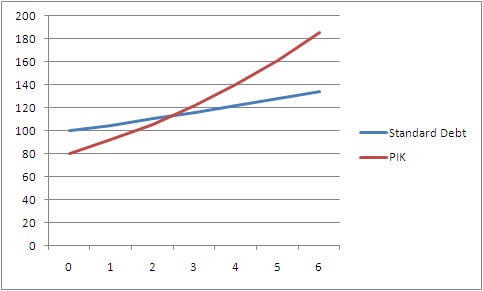
In our discussions in our Managing Corporate Turnarounds class during our financial restructuring session, I got to thinking about what it would take to be made whole in a bankruptcy scenario. While the hard math will tell you that it is impossible in the short term (EV = 80, Net Debt = 100), I began to think back to the PIK and using a high yield to restore value in the future. So my question became this: If I hold the debt of an insolvent company, what can I negotiate to help me restore value? The most obvious solution is to renegotiate the terms of my debt which will probably result in me taking a haircut (discount) on the principal or face value of my debt. However, we’ve acknowledged that in scenarios where people become riskier, obviously the company’s related securities should bear a higher return. So my question then evolved to: If I have to take a discount of X percent, what additional spread Y would I have to earn in order to be made whole in N years. It turns out:

FV x (1 + kd) ^ N = FV x (1 – X) x (1 + kd + Y) ^ N


However, this assumes that you can break even with (or more accurately, catch up to) where your security would have been if the company had not defaulted to begin with. After playing with these numbers, however, it was quite clear that even with a small discount (say 20% discount), the spread Y had to be astronomically (unreasonably) higher in order to have any chance of being made whole relative to the standard debt, so I thought it would be unrealistic not to include a factor which accounts for the value lost:

FV x (1 + kd) ^ N = FV x (1 – X) x (1 + kd + Y) ^ N + Value Lost


In trying to understand what these numbers mean, I looked at Value Lost / FV as a proxy for the default rate of this type of security in distress which is obviously closely tied to the actual economic circumstances of the company. In the graph, it is reflected by the distance between the Standard Debt curve and the PIK (Realistic) curve.

Also, Y can probably be determined by looking at the spread between similar bonds with different credit ratings (dropping from BBB to C for instance).

X is reflective of the economic scenario (so if EV was 80 and Net Debt was 100, X would be 20%). It is also reflective of the negotiations, as well as considering a discount in order to liquidate the current assets of the company.

Another problem is also that once a company switches from PIK to cash sweep, its risk profile drops and it stops earning high yields, dropping the return on capital and therefore making it impossible to “catch up”. Also, a bank which was happy to finance your debt will not be interested in converting neither into a mezzanine structure better suited for hedge funds nor into equity.

This model is similar to the VC model of predicting the failure rate using the discount rate except in reverse. It is also similar to the interest rate parity (IRP) model and boot strapping by using compounding to determine where you would have / should have been otherwise as a benchmark for where you are going.

I guess the real lesson is that bankruptcy is really expensive and that being made whole in this scenario is difficult, regardless of the financial engineering and patience, although these two factors can be used to ease the pain.

Thursday, March 31, 2011

Managing Corporate Turnarounds - Part II

Wednesday

Often when things go wrong, people are inclined to fire the management. However, in the real world, things are hardly ever that simple. Firing management, like anything in turnarounds, is decided on whether or not this action will speed up or slow down the turnaround. Besides packages given to executives on exit, there is also a great deal of institutional knowledge that they take with them. There is a counter balance to understanding the value they bring through their experience versus the inertia they create against the changes required. This is particularly true in SMEs as well as family owned enterprises where the institutional knowledge is often not formalized (pricing mechanics, customer relationships etc.)

Also, with the separation of the chairman and CEO roles, it is possible that a power divide coupled with an inappropriate strategy may have smart people being told to chase bad strategies. One remedy which is often used is an immunity period: the idea that employees in a turnaround situation have a window of opportunity to identify any potential problems. This allows an honest analysis of problems without reprimand and realigns expectations (Are we going to make the numbers? Are our margins as good as we expect? Are we doing things right? Are we doing the right things?) Because a new team is put into place to fix previously created problems, it is not appropriate to assign current problems to new management. However, eventually, whether or not these issues were created by you initially you will inevitably begin to wear them if you don’t fix them soon enough or don’t manage expectations of the company and all stakeholders.

Thursday

Like in any business strategy, there are two major things to keep in mind in a restructuring: operations and financing. For operations, it is necessary to check if the overall business strategy works (are people buying your product and do you have a viable business) and if you are able to profitably deliver (are our margins good or are we chasing low quality customers). Also from a financing perspective, it is important to understand the liquidity constraints of the enterprise. For example, what is an appropriate financing structure to keep the company alive while providing adequate and appropriate protection and returns to current and new capital providers?

One such useful tool is the paid-in-kind (PIK) security. It is a type of mezzanine high yield debt that doesn’t pay a coupon. Typically, these types of securities return 14 to 17%. They return higher than senior debt because they are subordinated but they don’t require cash payments which allow the company to maintain its liquidity for short period of time when it’s heavily cash strapped. However, what usually happens is this is coupled with a cash sweep. To use a structure like this in this circumstance is tantamount to saying: “We understand you are strapped for cash now, so you don’t have to pay us immediately, but we want an appropriate return for taking this risk that’s more similar to equity if things recover. However, we still want to be paid sooner rather than later and when you have any excess cash, you will give us everything you have and we’ll consider you less risky and ratchet down your interest rate to reflect the change in risk.”

Tuesday, March 29, 2011

Artistry with Dr. Hilary Austen

Tonight, there was a Rotman panel discussion hosted at the Savoy Hotel in London by our dean, Roger Martin, on “Artistry Unleashed: Pursuing Great Performance in Work and Life” written by Dr. Hilary Austen. They had a great discussion on how our current educational system seems to focus heavily on quantitative knowledge potentially at the expense of qualitative knowledge which, although by definition difficult to measure, plays an important role not just in decision making, but our ability to perform well in different environments.

Vetran integrative thinkers can probably also recognize the concept of model tension between these two ideas and can appreciate that the conversation between the panelists with Roger facilitating lead to interesting perspectives and topics being raised (eg. the role of analytical versus intuitive recognition for diagnosis performed by doctors).

Afterwards, there was a cocktail reception with the opportunity to speak with people connected to the Rotman community in London through a variety of different channels: students like myself, alumni, business partners, patrons of business publications etc.

Managing Corporate Turnarounds

This week, I’m taking a block week course (one week intensive following the 10 week standard course period) at LBS: Managing Corporate Turnarounds. So far this course has actually been really interesting, with us looking at business cases for salvaging distressed companies and learning about the mechanics and considerations of struggling businesses.

Unlike my undergraduate strategy course, which I nicknamed “doom and gloom” because the distressed companies in our cases never seemed to recover, this course talks about different cases that were successfully turned around using a variety of different techniques to improve operational efficiencies and use financial tools like LBOs to capture the upside.

We’ve also had great guest speakers come talk about their specific experiences and their perspective on different aspects of turning companies around (shedding assets for cash, improving operations, recovering debt, how to identify target companies etc.) One of our requirements in class is to summarize some key learnings from the class, and in a similar fashion to the Latin America study tour which had a similar component, I plan on using this blog to jot a few notes for me to recall later as I compile my thoughts:

Monday

In turning a company around, it is important to understand where control lies. Since equity is flirting with bankruptcy, it may lose control to the debt holders. Some debt investors may be holding “grenades”, the intent to liquidate their holdings ASAP when a trigger event happens (broken covenants, default etc), and may not be interested in salvaging the company, even if there is potential to recover equity value because they just want to unwind their positions.

Companies need to have good strategies when it comes to M&A, otherwise they can fall victim of a vicious cycle: accretive acquisitions increase EPS (albeit in an inorganic manner) and can give false impressions of growth, which could potentially boost the P/E multiple. A higher P/E multiple gives the company expensive equity which it can use as a better transaction currency for buying other companies (low P/E) and still be accretive. This is a vicious cycle if the M&A is not well integrated with substantial delivery of synergies and/or overpays for targets. This typically occurs in new industries where there are a limited number of potential buyers (targets with low P/Es as there is no other mechanism for exit) and the industry is consolidating into larger players (large strategic buyers displace financial buyers niche shopping).

Another version of the problem above is when companies which are asset-light use M&A as a backdoor for raising leverage. Services companies cannot raise leverage in a traditional manner because they have neither hard assets nor collateral to borrow against, so they can acquire companies which have higher leverage ratios to boost their own ratios. Also, this type of reckless acquisition can divert focus from the core business. In turning around companies which have fallen along this path, one of the immediate remedies is to spin off non-core assets for cash.

Tuesday

When you are on the buyside for any company (not just distressed companies for turnaround), it is important to have multiple targets in the pipe, not just for the more obvious negotiation leverage points, but to prevent yourself from getting too much deal heat over one deal and to avoid negotiating against yourself and your emotions.

Negotiating a transaction involves much more than a “price”. There are terms of payment, the structure of the compensation, workouts, milestones, terms and conditions. A price which is seemingly too high can be restructured to be paid out overtime so that the undiscounted amount remains the same, but the risk and cash outflows can be spread over a longer period with the appropriate covenants and milestones.

Thursday, March 24, 2011

Travelling in Europe

The bizarre truth is that it’s actually cheaper to visit other parts of Europe than it is to stay in London. With the end of the term (and MBA program) upon us, many students (exchange especially) are planning a variety of trips before the academic program is over.
(Shown above: Bull fight, La Plaza de Toros de Las Ventas, Madrid, Spain)

So far this week, I’ve been to Madrid, Spain and Bordeaux, France. I'm travelling with a few students from LBS and we are driving down the coast of the south of France and into northern Spain, visiting coastal towns as we make our way down and are currently San Sebastian, Spain. My French has been a bit rusty, but enough to decipher menus, make orders, ask directions and generally get around. It has been almost 5 years since my CFES days.

(Shown above: Chateau Margaux, Bordeaux, France)

(Shown below: San Sebastian, Spain)

Having visited Lisbon, Portugal and Rome, Italy there is only one other country I need to visit to collect my PIGS set: I plan on visiting Greece in early April for my final block week course: Service Management Field trip, a consulting project based in Thessaloniki, Greece.

I have always enjoyed Greek mythology, especially after reading the Odyssey in high school which was one of my favourite books of all time. I will certainly enjoy spending time in Athens visiting some of the ancient ruins. Greece is also home to many famous mathematicians and philosophers that derived such elegant concepts such as the approximation of pi or the golden ratio. I'm really looking forward to the trip.

Tuesday, March 15, 2011

Emerging Markets - China

We just completed our final presentation in the Emerging Markets class taught by Linda Yueh at LBS. Our group chose China, and we did a cross section of important business factors and how they affect investment decisions and mechanisms into the country. While the presentation was performed by myself and my classmate Tim, the other team members contributed greatly to the material and their preparation was reflective in the cohesive and comprehensive story we presented. It was easy to present the highly refined material to create an investment thesis branching across a broad range of industries and tell a story about how specific companies would benefit or be hindered by government regulations and financial market mechanisms.

Tim did a great job going into the details of the domestic business environment with some personal anecdotes from some of our team members’ recent trip to China. JEMBAs (aka January intake Executive MBAs) at LBS are required to a week intensive in a foreign country and three of our JEMBA team members visited China together.

I think we represented the hard work and analysis of our team well.

Monday, March 14, 2011

Planned Obsolescence

With the last week of the core 10 week period upon us at LBS, things have dramatically started to pick up. I have my final exam for Behavioural Finance on Thursday which promises to be challenging.

I've also got a final PEVC assignment due in-class tomorrow where our take home individual case will also be released. Also, tomorrow, I have a big presentation for Emerging Markets with the final group and individual papers due by the 18th.

What a roller coaster it's been, not just here but in the MBA program in general. It seems like not too long ago, I was stepping into Rotman for the first time. After taking a look back at this blog, I've realized how much I've enjoyed my time at Rotman. And with the end of the program so near, it's time to plan wrapping up of all the loose ends.

I have two more classes left, block week courses (one week intensives) which I'll be taking between now and the end of April. However, this provides me with ample opportunity to take advantage of the easy access to Europe and as such I'm planning trips with some of the fellow exchange students between now and when I leave. My last two classes are Managing Corporate Turnarounds (last week of March) and Service Management Field trip, a consulting project where our class will be in Greece (jokingly referred to as "exchange on exchange") which will be my final class of the MBA program.

I'll continue to blog as interesting ideas pop up in the last few classes and probably put up a few nice pictures from my travels, but I expect that I'll put up a final post around the end of April as I head back to Toronto.

Wednesday, March 9, 2011

FEI Competition

Apparently, our final round presentation for the Financial Executives International Case Competition is now available online. Unfortunately, I can't embed it into the blog, but I can include the link below:

http://www.feicanada.org/cfo-tv.php?vid=22&page=2

Enjoy!

KKR at LBS - Socially Responsible Private Equity

Just now, we had the inaugural talk for the Socially Responsible Private Equity talk given by Ken Mehlman, KKR's Global Head of Public Affairs. He was the Chairman of the United States Republican Party, campaign manager for President George W. Bush's re-election campaign, and White House Political Director. He was also a classmate of Barack Obama at Harvard Law.

He gave a great talk on how social responsibility is integral to sustainability of a business, especially one with patient capital in PE. One point he made which I thought was particularly poignant seemed to echo the ideas of Integrative Thinking. He said that there are generally two common models with regards to social responsibility:

  1. Corporate CSR – Where a company makes contributions to organizations outside of its operations that show it cares.
  2. It focuses solely on strong operations and generating business returns to the bottom line without much consideration for social responsibility.
He mentioned that KKR takes a third approach, and that it integrates social responsibility not just at some abstract corporate or portfolio level, but right down to the alignment of its operations to produce. Examples of this would include involving a broader definition of stakeholders versus shareholders such as environmental agencies and unions in determining the best course of action for a company’s future operations and how it should be run.

Besides some of the insightful deal war stories, future PE trends and industry knowledge he shared, he also gave great advice on what he thought it took to be successful which was well received by the crowd.

There were a host of excellent questions asked by the crowd in the Q&A session as well as the cocktail reception following. I’m looking forward to the next event hosted by the PEVC club.

Tuesday, March 8, 2011

MAJUP

The past few weeks have been pretty busy with a variety of events. LBS hosted its first combined TMT conference with the technology and media club on Friday Feb 25th with speakers on topics such as new revenue streams for IPTV and the forecast for cloud computing. There was one particularly interesting speaker who equated using cloud computing to storing informational currency in a bank. While you appear to be giving up control in the form of a physical box hosted on site, the security and convenience of cloud computing is similar to withdrawing money from an ATM.

That weekend I had some friends from Barcelona visiting (they were going to pursue careers in the TMT space) and they also had the fortune to stay for Tattoo, a school wide celebration of cultural diversity with artistic and gastronomic displays. The entire school was set up with tents as students prepared food native to their homelands wearing traditional dress and putting on performances to display their artistic talents.

This past weekend was spent in Lisbon. With exams coming up, it was a good opportunity for the exchange students to have one big go at a trip before many of us run off at the end of the 10 week term period. Time seems to have flown by as we are already in March.