Showing posts with label Bankruptcy. Show all posts

Saturday, April 2, 2011

Being Made Whole in Bankruptcy

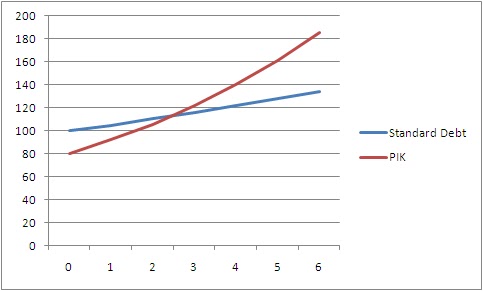
In our discussions in our Managing Corporate Turnarounds class during our financial restructuring session, I got to thinking about what it would take to be made whole in a bankruptcy scenario. While the hard math will tell you that it is impossible in the short term (EV = 80, Net Debt = 100), I began to think back to the PIK and using a high yield to restore value in the future. So my question became this: If I hold the debt of an insolvent company, what can I negotiate to help me restore value? The most obvious solution is to renegotiate the terms of my debt which will probably result in me taking a haircut (discount) on the principal or face value of my debt. However, we’ve acknowledged that in scenarios where people become riskier, obviously the company’s related securities should bear a higher return. So my question then evolved to: If I have to take a discount of X percent, what additional spread Y would I have to earn in order to be made whole in N years. It turns out:

FV x (1 + kd) ^ N = FV x (1 – X) x (1 + kd + Y) ^ N


However, this assumes that you can break even with (or more accurately, catch up to) where your security would have been if the company had not defaulted to begin with. After playing with these numbers, however, it was quite clear that even with a small discount (say 20% discount), the spread Y had to be astronomically (unreasonably) higher in order to have any chance of being made whole relative to the standard debt, so I thought it would be unrealistic not to include a factor which accounts for the value lost:

FV x (1 + kd) ^ N = FV x (1 – X) x (1 + kd + Y) ^ N + Value Lost


In trying to understand what these numbers mean, I looked at Value Lost / FV as a proxy for the default rate of this type of security in distress which is obviously closely tied to the actual economic circumstances of the company. In the graph, it is reflected by the distance between the Standard Debt curve and the PIK (Realistic) curve.

Also, Y can probably be determined by looking at the spread between similar bonds with different credit ratings (dropping from BBB to C for instance).

X is reflective of the economic scenario (so if EV was 80 and Net Debt was 100, X would be 20%). It is also reflective of the negotiations, as well as considering a discount in order to liquidate the current assets of the company.

Another problem is also that once a company switches from PIK to cash sweep, its risk profile drops and it stops earning high yields, dropping the return on capital and therefore making it impossible to “catch up”. Also, a bank which was happy to finance your debt will not be interested in converting neither into a mezzanine structure better suited for hedge funds nor into equity.

This model is similar to the VC model of predicting the failure rate using the discount rate except in reverse. It is also similar to the interest rate parity (IRP) model and boot strapping by using compounding to determine where you would have / should have been otherwise as a benchmark for where you are going.

I guess the real lesson is that bankruptcy is really expensive and that being made whole in this scenario is difficult, regardless of the financial engineering and patience, although these two factors can be used to ease the pain.

Thursday, March 31, 2011

Managing Corporate Turnarounds - Part II

Wednesday

Often when things go wrong, people are inclined to fire the management. However, in the real world, things are hardly ever that simple. Firing management, like anything in turnarounds, is decided on whether or not this action will speed up or slow down the turnaround. Besides packages given to executives on exit, there is also a great deal of institutional knowledge that they take with them. There is a counter balance to understanding the value they bring through their experience versus the inertia they create against the changes required. This is particularly true in SMEs as well as family owned enterprises where the institutional knowledge is often not formalized (pricing mechanics, customer relationships etc.)

Also, with the separation of the chairman and CEO roles, it is possible that a power divide coupled with an inappropriate strategy may have smart people being told to chase bad strategies. One remedy which is often used is an immunity period: the idea that employees in a turnaround situation have a window of opportunity to identify any potential problems. This allows an honest analysis of problems without reprimand and realigns expectations (Are we going to make the numbers? Are our margins as good as we expect? Are we doing things right? Are we doing the right things?) Because a new team is put into place to fix previously created problems, it is not appropriate to assign current problems to new management. However, eventually, whether or not these issues were created by you initially you will inevitably begin to wear them if you don’t fix them soon enough or don’t manage expectations of the company and all stakeholders.

Thursday

Like in any business strategy, there are two major things to keep in mind in a restructuring: operations and financing. For operations, it is necessary to check if the overall business strategy works (are people buying your product and do you have a viable business) and if you are able to profitably deliver (are our margins good or are we chasing low quality customers). Also from a financing perspective, it is important to understand the liquidity constraints of the enterprise. For example, what is an appropriate financing structure to keep the company alive while providing adequate and appropriate protection and returns to current and new capital providers?

One such useful tool is the paid-in-kind (PIK) security. It is a type of mezzanine high yield debt that doesn’t pay a coupon. Typically, these types of securities return 14 to 17%. They return higher than senior debt because they are subordinated but they don’t require cash payments which allow the company to maintain its liquidity for short period of time when it’s heavily cash strapped. However, what usually happens is this is coupled with a cash sweep. To use a structure like this in this circumstance is tantamount to saying: “We understand you are strapped for cash now, so you don’t have to pay us immediately, but we want an appropriate return for taking this risk that’s more similar to equity if things recover. However, we still want to be paid sooner rather than later and when you have any excess cash, you will give us everything you have and we’ll consider you less risky and ratchet down your interest rate to reflect the change in risk.”

Tuesday, March 29, 2011

Managing Corporate Turnarounds

This week, I’m taking a block week course (one week intensive following the 10 week standard course period) at LBS: Managing Corporate Turnarounds. So far this course has actually been really interesting, with us looking at business cases for salvaging distressed companies and learning about the mechanics and considerations of struggling businesses.

Unlike my undergraduate strategy course, which I nicknamed “doom and gloom” because the distressed companies in our cases never seemed to recover, this course talks about different cases that were successfully turned around using a variety of different techniques to improve operational efficiencies and use financial tools like LBOs to capture the upside.

We’ve also had great guest speakers come talk about their specific experiences and their perspective on different aspects of turning companies around (shedding assets for cash, improving operations, recovering debt, how to identify target companies etc.) One of our requirements in class is to summarize some key learnings from the class, and in a similar fashion to the Latin America study tour which had a similar component, I plan on using this blog to jot a few notes for me to recall later as I compile my thoughts:

Monday

In turning a company around, it is important to understand where control lies. Since equity is flirting with bankruptcy, it may lose control to the debt holders. Some debt investors may be holding “grenades”, the intent to liquidate their holdings ASAP when a trigger event happens (broken covenants, default etc), and may not be interested in salvaging the company, even if there is potential to recover equity value because they just want to unwind their positions.

Companies need to have good strategies when it comes to M&A, otherwise they can fall victim of a vicious cycle: accretive acquisitions increase EPS (albeit in an inorganic manner) and can give false impressions of growth, which could potentially boost the P/E multiple. A higher P/E multiple gives the company expensive equity which it can use as a better transaction currency for buying other companies (low P/E) and still be accretive. This is a vicious cycle if the M&A is not well integrated with substantial delivery of synergies and/or overpays for targets. This typically occurs in new industries where there are a limited number of potential buyers (targets with low P/Es as there is no other mechanism for exit) and the industry is consolidating into larger players (large strategic buyers displace financial buyers niche shopping).

Another version of the problem above is when companies which are asset-light use M&A as a backdoor for raising leverage. Services companies cannot raise leverage in a traditional manner because they have neither hard assets nor collateral to borrow against, so they can acquire companies which have higher leverage ratios to boost their own ratios. Also, this type of reckless acquisition can divert focus from the core business. In turning around companies which have fallen along this path, one of the immediate remedies is to spin off non-core assets for cash.

Tuesday

When you are on the buyside for any company (not just distressed companies for turnaround), it is important to have multiple targets in the pipe, not just for the more obvious negotiation leverage points, but to prevent yourself from getting too much deal heat over one deal and to avoid negotiating against yourself and your emotions.

Negotiating a transaction involves much more than a “price”. There are terms of payment, the structure of the compensation, workouts, milestones, terms and conditions. A price which is seemingly too high can be restructured to be paid out overtime so that the undiscounted amount remains the same, but the risk and cash outflows can be spread over a longer period with the appropriate covenants and milestones.

Thursday, November 25, 2010

Abnormal Earnings Method – Not Entirely Useless

When we were introduced to the Abnormal Earnings method in Business Analysis and Valuation, I was decomposing the math formula which constructs the value of the equity. As far as I was concerned, it didn’t really tell us anything we didn’t already know through a equity based discounted cash flow (FCFE discounted at re).

However, there was an interesting scenario in which this method actually told us something unique. First the formula:

Market Value = Book Value + (NI1 – re*BV)/re + (NI2 – re*BV)/re^2 + …

Nix is Net Income in year x

BV is book value

While in theory, this formula should return a similar value to an equity based DCF, one unique value is that the valuation is relative to book value, rather than strictly looking at only cash flows. Essentially, what it is saying is, the company is worth it’s book value, PLUS it’s “abnormal earnings” where abnormal earnings are the earnings you get in excess of what you would expect (re).

So in looking at a company that is trading below book value, I used to think that it meant that the market did not believe in the company’s management to perform (the company was burning cash). But it doesn’t just have to be that the company is on a “crash” course. It could also just be that the company is not performing as “expected” that is to say there net income is not necessarily negative, but simply less than what is expected.

Friday, October 22, 2010

Financial Management Presentation

Yesterday, my team had our presentation for Financial Management with Asher Drory, a professor notorious for not pulling any punches and generally holding all Rotman students to a very high standard. We didn't want to disappoint.

Our case was on securitization as a form of financing. The company was a collections company which bought bad loans for pennies on the dollar and made a profit by collecting on them. However, they were being squeezed on the margins due to banks beginning to charge more for the bad debts as well as the quality and collectability of the debts shrinking.

The company was also looking to grow, and had been previously financing its growth through the securitization of it's uncollected loans (in this specialized financial industry, loans are a form of inventory, rather than as a liability in a traditional company). However, the conditions of the security were almost exactly the same as debt (monthly interest payments and principal flowthrough).

Therefore, in order to properly understand the risk exposure in the company, rather than have the financing sit off the balance sheet, we made adjustments to show what the balance sheet would look like if they were financed with traditional debt (which is not an unreasonable assumption, given the type of business risk that they are exposed to through this financing is not dissimilar). The end result is that suddenly all their solvency ratios and coverage ratios are totally out of whack. Whereas before their company had reasonable ratios (debt to equity of about 0.8x), their ratios were now about 4 to 5x.

Thursday, October 14, 2010

Accounting – The Story Behind the Numbers

It seems like the major topic for this week has been related to working capital. In our financial management course, however, there was a great example case where simply knowing the numbers is not enough.

Simplified Case Info (expressed in thousands):

Revenue = 17805
AR = 6000
Average Day’s Receivable in the industry = 59 days

Analysis:

Company’s Average Day’s Receivable = 123 days

Proposed financing solution: Collect on AR to reduce Day’s Receivable to industry average of 59 days.

If Days Receivable = 59 days, implied new AR is 2878. The change in AR would be 6000 – 2878 or 3122.

So looking at this *mathematical* solution, it seems as if the company can get a free 3 million dollars just by tightening its AR, right? Well as it turns out probably not. The reason?

Most companies define default as non-payment of debts of 90 days or more. Previously, we’ve talked about how debts decay in value as they are outstanding for longer and longer (probability of collection and bad debt expense). If you look at this number, essentially what it is saying that the many of your accounts are in default with an average age of 120 days!

Sometimes you can’t just assume you can make operational changes to reflect a reality that you want. The truth of the matter is that those funds are probably lost. The firm probably won’t collect those accounts and will incur a significant bad debt expense.

In reading more of the case, it also mentioned that the company had a “no returns” policy with its distribution channel partners. Looking at this number not only meant that they probably weren’t going to collect, but that their distributors were telling them that they didn’t want to do business with them any more (affecting their potential future revenue growth). Not only will they not be able to pull 3 million dollars out of working capital, there are some critical red flags appearing about their ability to continue as an ongoing concern.

Wednesday, May 5, 2010

Bom Bril

[LAIST Tour Begins, Fazenda Tozan, Churrascaria – Nova Pampa, Port of Santos, Deloitte, Embraer, Natura, Gol de Letra, Bom Bril, Agencia Click, Nextel Institute, May 6, Rio, Rio Weekend, Petrobras, PREVI]

Gustavo Ramos, former UofT Engineering student (class of ’95) and Columbia MBA (’01) and CEO of Bom Bril, gave us a presentation on his involvement in the company since arriving in 2006 and finding Bom Bril, a leading manufacturer of consumer products, on the verge of bankruptcy and in receivership with the government. Bom Bril had delayed payables such as wages to employees and had not paid any taxes. The largest liability was to the government in the form of unpaid tax.

Having never worked in a distressed company before, Gustavo smiles as he recalls how he approached the problem: His professor at Columbia had said that gold rule of finance: “Cash is king”.

With his work cut out for him, Gustavo started to fix the problems, first by negotiating a 15 year payment schedule to alleviate the government debt. He proceeded to adjust prices and margins on products, renegotiate with suppliers (focusing on the value of Bom Bril to the industry as an ongoing concern) to reduce working capital and cutting marketing spending.

Gustavo generally tried to insulate the end consumer from the financial problems at Bom Bril as well as the lower level employees (no layoffs). When asked if Bom Bril was ever a takeover target, he mentioned the 2001 attempt by Clorox to take over Bom Bril which fell through when Clorox balked at the liabilities on their balance sheet at the due diligence stage.

In my opinion, I think this was a very bold strategy that worked for Bom Bril and reminds me of our Coca Cola case that we had with Anita McGahan in Strategy I, when we were talking about the intangible value of Coca Cola and why that couldn’t be duplicated by Sir Richard Branson in his attempt to introduce Virgin Cola. Although Virgin Cola’s annual spend on marketing was equal to Coca Cola, Coke had built up a tremendous amount of brand equity over its history dating back to world wars and that wasn’t going to be reproduced over night. In the same way, I expect that Bom Bril’s strong brand equity allowed them to coast briefly as Gustavo put their ship back in order. Either way, it was a bold move which has been attributed to the companies turn around.

With the return of Bom Bril to profitable status (with 40% growth and a 17% EBITDA margin), Gustavo laid out his plans for the future of Bom Bril:

  • Remodel product lines – expand, change formulas, improve the packaging
  • Launch new product categories – clothing care, silver and brass polish with all new products branded with Bom Bril
  • Heavily reinvest in marketing to make up for lost time – Launching new brands and supporting old ones. Having a spend that focuses on the Point of Sale rather than just mass marketing. Marketing is budgeted at 5% of sales

He also explained how Brazil’s market for Consumer Product Goods (CPGs) are different than in Canada. Where we are familiar with large distributors and retailers (such as Tesco, Carrefour, Loblaws, Walmart, etc. which only account for 15% of Brazil’s CPG market) where we drive our cars to the store, Brazilians walk to the local mom and pop shop and distributors have a much more difficult time managing the various touch points.

He acknowledges the 3 most important factors for CPG: Brand equity, distribution channels and low cost / scale.

Recently, Bom Bril’s new found success has increased its appetite for acquisitions, having purchased Lysoform, a European disinfection product to add to its repertoire of products. Bom Bril continues to expand, looking for acquisitions or partners who are leaders in niche categories to fill the blanks in their portfolio.

In understanding Bom Bril’s business, we learned about the exclusive nature of relationships with Bom Bril’s distribution network and the economies of scale achieved with non-competitive products where the high costs of the fragmented distribution network could be shared with partners like Kraft.

Their COGS are generally (80 to 85%) composed of raw material costs and they are therefore sensitive to changes in the price of iron ore, the primary ingredient of their flagship “Bom Bril” product, an inexpensive steel wool whose name is almost generisized in the same way as Kleenex and Band-Aid.

Bom Bril is also the first company to release a line of eco products in Brazil: “Ecobril”. Their ideology has been successful on the premise that performance and cost (retail price) are the primary drivers of success in this CPG space, and ecologically friendly is a tertiary concern. This caps their price of their products at 10 to 20% MAX above the price of their normal products. However, by balancing these pillars, they have had success beyond other entrants into the eco space. They also focus on the 4 R’s, which are the 3 R’s we are used to plus “Respect for Biodiversity” which acknowledges their use of natural raw materials versus synthetic and no animal testing.

Another interesting story about Bom Bril’s EcoBril line is that some of the products have the options of buying refills. The irony is at this stage, the cost to manufacture the refill is almost the same as the original packed bottle (due to low economies of scale), however, the nature of the business is to charge 30% less. With increased economies of scale, Bom Bril expects to bring this price down making eco refills more attractive as a product line to Bom Bril in the long run.

Bom Bril’s history is quite fascinating and integrated into the social fabric of Brazil as a staple CPG company and product. Mr. Bom Bril, played by Carlos Moreano, is a local celebrity how has the accolade of being the longest running ad campaign series as noted in the 1995 Guiness Book of World Records.The visit to Bom Bril concluded with a walk through their factory (no photos permitted), but it was interesting to see the unique history (and plans for the future) of the company.
Thursday, February 25, 2010

Tax Implications of Bankruptcy

One thing that I've always been fascinated with (and need to look into more) is mergers and acquisitions. However, in this environment of post-financial crisis recovery, the M&A environment is very different that what it was previously. Particularly, there was a good window recently of purchasing companies at a 50% off sale with equity prices so low if only you had the cash to do it.

One thing we discussed in financial modeling courses I've taken looks at modeling Tax Loss Carry Forwards (TLCF, Canadian) and Net Operating Loss (NOL, American).

As a financial acquirer (rather than a strategic acquirer), I wonder if there are any vulture funds which specialize in purchasing bankrupt companies if only to get their hands on their TLCF / NOLs. Obviously, there are some concerns, including the laws, regulations and transfer rules for obtaining these credits as well as what the capital structure of the acquiring company looks like. I'd imagine that the equity would be worthless (or trading like an option) and the debt would be trading for pennies on the dollar.

Especially with so many failed entrepreneurial ventures, there must be a sea of dead companies which should at least be as valuable as their potential tax credits. This could also potentially reduce the exit cost of early stage companies (for early investors to at least recoup the cost of the tax credits for all losses taken).

Having said that, would it be a potentially good idea to go out looking for strong companies to purchase distressed companies if only to utilize their tax credits? That is to say to purchase these companies only for their deferred tax assets. Or some other metric like break up value or price to book.

Saturday, February 20, 2010

Equity Near Bankruptcy (or NPV = 0) Behaving as Call Options

This might be one of the most brilliant finance things I've ever seen taught a few days ago by our finance prof. I've always been interested in options thinking about how they behave and how to value them (and with the current financial crisis, have been taking more looks at bankruptcy).

First consider an oil company which can extract oil out of the ground for $70 per barrel with 1M barrels in the ground. The current cost of oil is $60. It costs more to get the oil out of the ground than it does to sell it on the open market, so the project is negative NPV right?

Well what happens if the oil prices rise to $80 a year from now? Then with a return of 10% (assume that it takes a year to get the oil out), you can make $10 per barrel on 1M barrels. The NPV works out to be about $9.1M.

But there is some inherent risk in this position which relies on the price of oil moving up. Sound familiar? It is the exact same behaviour as a call option.If the value of oil drops, the land is worth nothing, but if the value of oil appreciates, the value of oil appreciates accordingly also. The analogy holds up if you replace Exercise Price with Extraction Cost.

Here is another example of option like behaviour: Companies near bankruptcy.

Scenario 1: Healthy
Net Debt = $5M
Enterprise Value = 11M (Enterprise value calculated based on DCF)
Market Cap = 6M

Scenario 2: Near Bankruptcy / Highly leveraged:
Net Debt = 5M
EV = 6M
Market Cap =1M

Scenario 3: Bankruptcy
Net Debt = 5M
EV = 4M
Market Cap = 0

Because of the nature of capital at risk for corporations, the equity cannot fall below zero. A company in this position might also take on excessive risk (deliberately stir volatility on extremely risky projects) because there is nothing to lose.

However, in the absence of that, a company's equity at or near bankruptcy will be have much like a call option. Because of this relationship, a vulture fund might use the Black-Scholes model could potentially apply as an appropriate valuation metric to value the time value of the equity.

Monday, February 15, 2010

The 4 C's of Credit

I have some friends who are looking at trying to gain positions in Fixed Income so I thought I would have a quick review of the 4 C's of Credit. They are:
  1. Character - The management team's record, strategy and internal controls
  2. Capacity - Ability to meet debt obligations
  3. Collateral - Assets pledged to back the loan
  4. Covenants - Restrictions on activities as well as maintenance
Recall that in bankruptcy, there is a hierarchy to how remaining capital, collateral and other assets are distributed relative to tranches. However, in restructuring "everyone gets a haircut".

Also, when building credit ratings, there are various ratios that are looked at, particularly:

Friday, November 27, 2009

Dubai World in Trouble

I've had this article (or variants) sent to me from many different people who are concerned / aware of what is happening in Dubai.

We had just done our Dubai presentation on market entry (our project was done on Sugar Mountain and their positioning with international infrastructure to source confectionaries from around the world) and were looking at different possible locations.

We had discovered Dubai World in our research and commented on how monsterously large it was. It actually dwarfs other famous projects from the same real estate development company, Nakheel, such as the famous World project, which creates small artificial islands on the coast in the shape of the earth.

An interesting point, the financing involve is actually islamicly based, as the bonds are sukuks. But there are interesting implications when it involves default and unwinding financial positions which have islamic components. It will be an interesting lesson in understanding not only islamic financial instruments, but also a pragmatic lesson in how distressed islamic investment instruments.

I wonder how liquidation would work. One of the general tenants (as I understand it) of islamic finance is that there are not many recourses for default, however, bonds do have an equity component so I wonder if the bonds will just naturally "convert" if the bond (sukuk) holders do not agree to delaying / suspending payments.

Sunday, June 21, 2009

End of an Era, RIP Nortel

Yesterday, Nortel announced that it will be selling it's wireless division to Nokia-Siemens for $650 million. It's noted that Nortel's wireless division is it's most valuable asset and that Nortel has plans to sell of it's other divisions as well as it liquidates its assets for bankruptcy.

This is also a good lesson in debt tranches, as although Nortel is liquidating it's assets, there isn't enough to cover the entire debt load (as is usually true with all bankruptcies). As a result, some debt holders will get heavily reduced value back for the Nortel debt they hold (and some none at all - the junior debt holders - preferred shares etc.). In this case, the obvious debt holders (from a finance perspective) are the holders of bonds and preferred shares etc, but also don't forget suppliers to Nortel (for instance, one of the larger holders of Nortel debt is reported a company which buys ad time for Nortel). After all, Accounts Payable is a fairly senior debt tranche.

This is in contrast to a restructuring in which "everyone gets a haircut" and holders of all forms of debt get some reduction. The idea is that there is a hope of recovery and everyone can get "something" back. However, in a bankruptcy, there is no illusions and the company is packing its things and closing shop.

Other notable points is that Nortel has made the sale contingent upon their employees of that division being given jobs with Nokia Siemens. In this scenario, where the division is actually valuable, it's isn't a bad thing. Generally, when buying parts of a failing company, there is usually an option to only take on the parts that you need. It's a fancy and seemingly cruel way of saying that an acquiring company can pick up only what they want in the sale (talent, equipment, intellectual property etc) and I think it makes sense. After all, with all due respect, the reason we are buying your division (especially in bankruptcy) is because there is something in it that doesn't work and we hope to fix (or "synergize" with our existing business). Buying things "as is" is generally not a good idea (especially in bankruptcy). However, as stated, this is one of the best chunks of Nortel, so it's forgivable in this circumstance.

Otherwise, it's usually a good reason to consolidate costs (systems, labour etc) and pick the best talent from both sides of the fence (as Jack Welch is such an avid proponent of). Yes, this implies possibly letting go of some of your own (his fifth sin of M&A - the "conqueror syndrome").

Nortel will be delisted, with it's final stocks closing price at 18.5c from highs in 2000 in the $120s. Look for Nortel stock certificates soon in Toronto convenience stores as souvenirs (just like Bre-X a few years back).

Friday, May 22, 2009

Financial Ratios, pt 3 - Solvency Ratios

[ Financial Ratios, Part: 1 - 2 - 3 - 4 ]

Solvency ratios are similar to liquidity ratios except that they focus on the long term ability of the firm to meet it's debt obligations. As a result, by looking at solvency ratios, you can determine leverage, coverage, etc.

Because solvency looks at the broadest measures of financial position, the terms which most often appear in solvency ratios are the bottom lines of balance sheets (Assets, Debt and Equity). Recall the fundamental accounting principle that

Assets = Liabilities + Equity

Basic Solvency Ratios:
Debt-to-Assets = Debt / Assets
Debt-to-Equity = Debt / Equity

Financial Leverage of Assets (FLA):
Financial Leverage = Assets / Equity

A critical part of DuPont Analysis, Financial Leverage also identifies the overall riskiness of the company (higher leverage = higher risk) and directly affects return on equity (ROE). Financial leverage is the cornerstone of financial investing and can turn a "good deal into a great deal".

Note that FLA can be determined from D/E.
FLA = A/E
= ((D+E) / E)
= E/E + D/E
= 1 + D/E

Interest Coverage:
Interest Coverage = EBIT / Interest Payments

Interest Coverage describes your ability to make interest payments. If this is less than 1 this is a *DISASTER*. It means that not only do you have enough money to make your interest payments, but you can't even begin to consider paying down your principle let alone think about profits. This also implies that your principle will grow (interest not immediately paid off becomes part of the new principle amount). I would expect any company with an interest coverage ratio of less than one is quickly and unceremoniously headed for bankruptcy.

By that very token, I would suggest that this ratio isn't actually very useful except to tell you how much trouble you are in (at a time when it's too late BTW). Since the numerator is EBIT (which is directly related to net income and retained earnings), you generally want this number as sustainably high as possible) so unlike some of the previous ratios, there is very little downside to having exorbitantly high interest coverage ratios.

Fixed Charge Coverage
Fixed Charge Coverage = [EBIT + lease payments] / [Interest + lease payments]

Similar to the idea of the interest coverage ratio, the fixed charge ratio takes into account lease payments. It is a little more all encompassing in that it also considers lease payments (not considered discretionary).

[ Financial Ratios, Part: 1 - 2 - 3 - 4 ]

Friday, May 1, 2009

Ontario Government purchases stake in Chrysler - Hawk Dove and Crowding Out

The Canadian Federal and Ontario Governments have decided to take a 2% equity stake in Chrysler. I don't know how Harper and McGuinty can make the justification that the "survival of GM and Chrysler were critical to the economic future of the province, and the country as a whole" when people essentially vote with their money by not purchasing cars and stating the exact opposite. Not to mention that other car companies seem to be suffering but surviving without government help (Toyota, Honda, etc).

Now a clever observer would ask: "Isn't criticizing Harper and McGuinty just politics as usual? Aren't they just copying the Obama administrations actions for improve the auto industry?" I would propose while it appears that way, this is hardly the case. The US administration has been constantly demanded reforms in the company such as ousting Rick Wagoner as CEO of GM, and the divesture of brands such as Pontiac. Their Canadian counterparts have made no such comparable efforts (mostly because they seemingly lack the leverage, but even if that appears to be the case its seems their money is still good).

Using a two by two matrix similar to the Hawk Dove model, it's easier to understand what's going on. If both the US government and Canadian government do nothing, the both economies will suffer. If one decides to bailout the automaker in their economy, the manufacturer will keep more capacity (jobs) in that country. If they both bail out the automaker, the manufacture will continue to split the capacity (jobs retained) between them, but more inefficiently (with the economic dead weight loss born indirectly by the tax payers through the government). Essentially, in that last scenario, they are fighting for the last piece of a rotten pie.
While the model show here is overly simplified (numbers are deliberately shown as negative values to show that this investment is essentially a "race for last" to see who will lose out the least), I hope it illustrates a few points. First, the numbers depict value as described by jobs lost. In any scenario (even with government intervention) jobs will be lost on both sides of the border. That is a given assumption.

The next point of note is that the Hawk Dove model shows that the two governments are essentially crowding each other out with their "investments" and that there is a sharp diminishing return.

While the weighting of each variable is highly debatable, I believe that the underlying logic and framework is fairly solid in describing the behaviour and results of each government in this arena.

Tuesday, April 28, 2009

UAW and Washington to own GM and Chrysler

With the recent decline of the Pontiac brand (hardly a surprise after Rick Wagoner's "modest" plan to sell of brands was deemed too conservative by Washington), there has been a flurry of activity. GM management proposed that Washington do a debt to equity swap with GM (for a 50% equity stake) and the UAW is looking to own a bigger piece (reported at 39% more).

The UAW is also looking to purchase up to 55% of Chrysler, with Fiat taking 35% and the rest picked up by the U.S. government and others. I think this is now an extremely exciting area to watch. The union essentially owns the company now with a controlling share and it will be interesting to see what happens next.

As I had previously mentioned in a post earlier this month, I wondered what would the next steps Chrysler would do to save themselves. I am happy to see the union pick up more ownership of the company. Although the unions had made some concessions, they were able to negotiate such that no changes were made to base pay while they gave up some other benefits (tuition reimbursements etc).

The capitalist markets seem to be doing what they are supposed to (despite the intervention of government) by lowering capacity of businesses that are becoming less relevant. However, I also understand the public's general concern when something in which a lot of value is built in over a long period of time begins a precipitous decline. This is exactly what Chapter 11 restructuring is supposed to do.

While I am happy with the proposed improvements, they are hardly out of the woods yet.

Monday, April 20, 2009

Price To Book - When EPS fails and you consider liquidation

Price to Book value is often quoted as an appropriate metric when EPS is not applicable but when does it apply? First, looking at the underlying logic of this solvency ratio:

P/B = Market price of all equity / Accounting Book value of company

Although there are generally two stages where negative EPS is characteristic (pre-mature growth and precipitous decline) I think the most appropriate use of this ratio is in liquidation (pre-decline). If negative EPS (or even negative operations income, NOI, manifested as negative operations cashflow versus positive invement and financing cash flow) is a result of growth, P/B will dramatically undervalue the ability of management and growth potential. A start up company will be dumping cash investments and financing in the hopes of future revenue.

I would propose that P/B is generally only useful as a ratio under very specific circumstances, particularly for use as a liquidation decision metric. For example, with a P/B of approximately 1, it would assume (that given perfect liquidity of remaining shareholder's equity) that for the cost for cutting up the company is approximately the same as it's acquiring price.

Therefore a P/B more than 1 means the company is overvalued compared to it's assets. This translates as either it is headed for decline (shorting opportunity) or investors think a turn around is possible with the difference reflecting "management value added" and potential growth of assets as is similar to any growing company.

This is the case that I would make to imply the P/B is a relatively useless decision metric for general investing, yet at the same time the only one that makes sense in the relatively narrow valuation space of liquidation.

Sunday, April 19, 2009

Simulated Reverse Dilution

We are all aware of dilution of EPS in common shares by the conversion of preferred shares to common and I've previously written about what affects the dilution decision for those holding convertible options. However, although this is a one way conversion, is it possible to simulate the reverse in a virtual reverse conversion?

While I suggest one possible alternative and it's reasoning, I think it becomes quite obvious why this doesn't happen (at least not directly).

First of all, a dilution conversion is taken in the circumstance when a company seems to be about to reach a tipping point of success as those holding the convertible options of preferred shares decide to convert to common shares. Until these conversion options expire, holders of the preferred shares would probably prefer to take their dividends (cash in pocket) until the last minute, maximizing the value of their options and reducing the risk of the company crashing in the interim. When the decision for the dilution decision is reached (depending on a variety of criteria) it is essentially based on the maturity and stability of the company.

This means that to take the reverse action is to bet against the maturity of the company. In the reverse analysis of the decision criteria, it assumes that EPS is weaker than dividends. In the scenario of an established company, this comes as a major red flag that the company is in distress if it is struggling to generate the necessary revenue to sustain it's cash payment obligations.

To simulate the reverse of a conversion, this would essentially mean shorting the common equity position and picking up preferred shares. However, assuming all preferred shares are converted and unless more preferred shares are issued, this is incredibly difficult (because there is nothing to buy to simulate the reverse conversion). Usually, the only comparable option is to pick up debt (short equity and go long on the companies bonds - a similar concept to the flight of quality).

However, if you are looking and manuevering solely in one company (rather than the entire market) and your only move is to reallocate your assets from equity to debt holdings, you are essentially burning down the house to get the insurance money. The corellation between these two assets (despite being in different asset classes) is extremely high. After all, a company experiencing distress won't only feel it in it's equity prices but probably also in it's solvency ratios (possibly reflecting a downgrade in it's credit rating).

As is unfortunately common practice in todays market, companies in distress are experiencing financial difficulties in both its debt ratings and equity value meaning that it will struggle to raise additional financing.

Vulture funds who see this coming will dump financial support of companies (perhaps even shorting them) in the hopes of picking up distressed funds for pennies on the dollar and looking for upside on the turn around and restructuring of the company. Obviously, this is incredibly risky as even distressed assets are cheap for a reason. Financial gravity is such that recoveries in such scenarios are often unlikely.

Although similar to deleveraging in many respects, focusing on distressed companies is different in that in the toughest times, everyone gets a "hair cut". Except for bankrupcy liquidation (Chapter 7) where senior debt has priority claim (and which is rarely used seeing as companies generally hate admitting defeat), restructuring (Chapter 11) is such that everyone who owns a stake, bond holders, mezzanine financing and even equity holders make concessions. Usually, this comes in the form of bond holders and mezz financing to take reduced claims while equity holders and other stakeholders (employees) make covenents (reduced wages, selling off non-performing divisions etc).

Wednesday, April 15, 2009

Fiat and Chrysler - Huge Changes Needed

Something is wrong with Chrysler. It's distressed and considering restructuring or bankruptcy protection. There are a host of problems with the company: expensive union labour / management layers, average quality products and declining demand. Fiat was looking to acquire Chrysler, but only if certain concessions are made. Fiat CEO Sergio Marchionne would be stupid not to ask for major changes. He is on the verge of buying garbage, and unless he has some incredible ground shaking plans for over hauling the company, he has to be incredibly careful to avoid disaster.

Whatever your opinion on management, unions and products Chrysler isn't working. And it will take a lot more than just some marginal improvements to bring it back. Union's make a good target because they have exceptionally high labour rates. It doesn't hurt the flow of criticism that the CAW demands seems to be out of touch with the current economic environment.

While supply side economists have often been criticized for being too laissez-faire when it comes to professing the need to let economy's crash and the strong survive (while many who own stock in weak companies are now reconsidering their positions - it's only painful when it happens to you), other economists have to acknowledge the real dangers of artificially inflated costs such as wages in the long run. In retrospect, this shouldn't really have come as a surprise.

And people will always point to other car companies doing well, such as Honda and Toyota saying that it is not impossible to succeed in the current environment. So why should hand outs be given to those who are failing?

I do sympathize with workers and pensioners who have lost a lot of the value of their pensions, however, I wonder how much of their pension plan was composed of Chrysler stock, or even how much of Chrysler stock made up any form of compensation package. How much were workers made to take ownership for the success of the company rather than simply try to negotiate a higher wage.

Rather than always have adversarial positions, was it not possible to compensate workers with ownership? This constantly seems to be a recurring theme in union relationships and the topic of entitlement. They are literally now in a position where they can all lose their jobs if they don't take a major pay cut.

I wouldn't call Marchionne predatory, I'd say he's looking not to get screwed. Unions pride themselves on being a democratic system. Marchionne is merely participating in a financially democratic way (as do other investors and customers of Chrysler), voting with his companies money on which what would be a good investment. Stakeholders of Chrysler are hoping that he doesn't end up voting with his feet.

There is a difference between bailing out AIG, an insurance company who is supposed to instill confidence in the system, versus a car company which was already on its way out. Same with dying newspapers.

The April 30th deadline is fast approaching and it looks increasingly as if this may be the end of the line for Chrysler.

Tuesday, March 31, 2009

Bad Time to be a CEO - Air Canada Surprise Move

Another CEO bites the dust, as Air Canada appoints Calin Rovinescu to replace Montie Brewer as CEO. With times being as bad as they are, it interesting that people are quietly and slyly asking these new CEO's (like the announcement of Nadir Mohamad replacing the late Ted Rogers at Rogers Communications yesterday afternoon) the same question that they were (jokingly) asking Obama on inauguration day: "In times like these, do you really want the job?"

I think a more honest question is what do you expect these new CEO's to do? Particularly in Air Canada's case, how will having Calin replace Montie really benefit the company? What will Calin do that Montie can't? Is there a strategy behind their shake up?

In my blog post about "Why Can't Canadian's Compete", I was actually thinking about Air Canada (even though I didn't explicitly write about it), but you can tell from the broad assumptions I made that these are the same types of challenges that plague Air Canada.

Air Canada struggled in the best of times with smaller companies like West Jet offering cheap domestic alternatives and eating up their market share. It seems like in the worst of times, even with low fuel costs Air Canada can't seem to catch a break. Despite all the points made for the case of a national airline, they seem to be laid to rest by the realities that prevent a self-sustaining profitability in this industry for Canadians (remember Canadian Airlines a few years ago? RIP and acquired by AC in 2001).

This raises an interesting question for consumers: Should you cash out your Aeroplan miles (frequent flyer program for Air Canada) now? Or would it be considered risky in case they go out of business and you are stranded (What happened to Zoom customers in late August of last year - and what I narrowly happened to avoid myself on a trip to Europe by only a few weeks).

Or would you even consider paying for a ticket of a potentially distressed airline? In a similar vein to comments about GM and other distressed companies, would you buy a car if you knew the automaker might not be there to honour the warranty? Have these companies past the tipping point of no return regarding consumer confidence?

This type of behaviour and thinking certainly won't help Air Canada (nor GM), but it must be a question all their customers are asking themselves.

Monday, March 30, 2009

GM Plans Insufficient - Big Surprise?

This should hardly come as a shocker to anyone. GM's management was unable to provide a compelling plan for recovery and Obama has ousted Rick Wagoner as CEO of GM (among many other demands for restructuring).

As far as timing for strategic change management goes, this is way too late in the game. So much needs to be fixed that it was ridiculous for anyone to think that a reasonable plan could be created by the end of March as was originally hoped for.

What I do find strange is that the government is asking GM to cut it's size so dramatically. A staple of government when it comes to politics is usually to save as many jobs as possible, however Wagoner's previous plan (proposed late last year) which "included the selloff of its Saturn, Hummer and Saab brands and the elimination of about 20,000 of the company's 90,000 jobs in the United States by 2012" hardly seems like it would be popular politics, but it's the government that is requesting more drastic action.

Perhaps these dramatic times are forcing politicians to take more hardlines also. I had previously critisized government "investment" in GM, but perhaps the politicians in Washington are trying to keep the angry tax payers at bay with all the recent attention on government deficit spending.